

Back Then: Why the 3-Column Format Came About
When Summary of Product Characteristics (SmPC) was still predominantly printed and distributed in folders, reference works, or as inserts, the familiar 3-column layout became the standard. The compact presentation made it possible to fit extensive information onto just a few pages while saving space and reducing printing costs.
For many years, this format was the optimal solution for the needs of the print world. Pharmaceutical companies provided their SmPC in this layout, and healthcare professionals were accustomed to using the content in printed form.
Today: SmPC Is Accessed Digitally
The way medical information is researched and used has fundamentally changed. Today, healthcare professionals primarily access up-to-date information online, regardless of whether they use a desktop computer, tablet, or smartphone.
With this shift, the requirements for presenting professional information are also changing. What was developed for print is not automatically the best solution for digital applications.
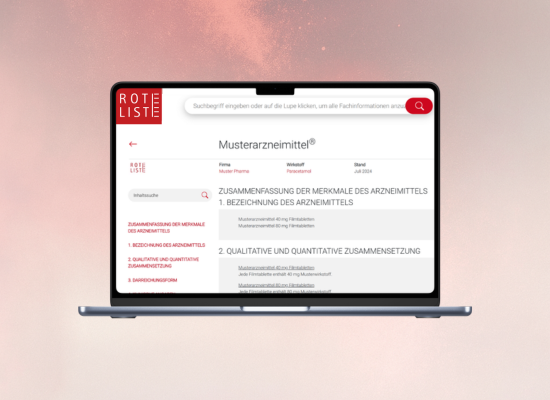
Modern HTML-based SmPC is therefore tailored to the needs of digital users:
-
Optimal display on all devices
-
Direct navigation to relevant sections
-
Fast full-text search within the document
-
Improved readability through clear structuring
-
Easy sharing via link or QR code
-
Always access the latest version
-
Responsive design instead of rigid page layouts
-
Direct content navigation
-
Improved discoverability of individual content
-
Comfortable reading even on smaller screens
The Path from Creation to Publication
The digital format also offers advantages for pharmaceutical companies.
While a 3-column PDF requires manual typesetting, which results in additional processing time, digital SmPC can be processed and published much more efficiently. Content can be made available more quickly, and updates can be implemented more easily.
In addition, the document’s original structure is preserved. Tables, headings, and text sections are displayed in a natural reading flow, which simplifies review and approval processes.
Greater User-Friendliness for Healthcare Professionals
Anyone researching information online today expects an intuitive user experience.
Digital technical information offers:
-
Direct navigation to content without detours
-
Easier discovery of specific content
-
A pleasant reading experience even on small screens
Extensive SmPC, in particular, benefits from this structure. Users can access the information they need more quickly and do not have to navigate through multi-column PDF documents.
Sustainability as an Additional Benefit
In addition to greater user-friendliness, the digital transformation also brings environmental benefits.
The more SmPC is made available and used digitally, the fewer printouts and printed copies are needed. This saves paper, reduces transportation costs, and prevents outdated printed versions.
Where a printed version is required, the digital technical information can also be automatically provided as a single-column PDF. In this way, the digital format combines the advantages of modern online use with the necessary flexibility for specific use cases.
The Future Is Digital
The three-column format has shaped SmPC for decades and was the right solution for the demands of the print world.
Today, the focus is on different requirements: rapid availability, easy updating, optimal usability on digital devices, and sustainable information delivery. Digital SmPC in HTML format meets these requirements and is increasingly becoming the new standard.